What gives a token value, and when it has none
Lesson 1 of 4
By the end of this lesson you’ll be able to name the job a token does, follow the money from a project’s users to its token holders, and recognize a token that has no job at all.
Start with the token’s job
A project and its token are two different things. A project can be busy, useful and well run while its token gets nothing from any of it. So the first question is what the token does, and only then whether the project is any good.
Most tokens that do anything do one or more of five jobs.
What it means
You need it to pay fees, the way ether pays for gas on Ethereum
The question to ask
Would people need it whatever its price?
What it means
Validators lock it up as a deposit and lose some of it if they cheat
The question to ask
How much is locked, and what are the validators paid with?
What it means
Holders decide changes to the project
The question to ask
What can a vote actually change, and who holds most of the votes?
Claims a share of the fees
What it means
Part of what users pay goes to holders, or buys tokens back and destroys them
The question to ask
How much, and who can switch it off?
What it means
You hold or spend it to use the product
The question to ask
Would the product work just as well without it?
A token with none of these jobs has nothing behind its price except what the next buyer will pay. It may trade for years all the same.
A job gives people a reason to want a token. None of the five tells you what the token is worth, or where its price will go.
Follow the fees from users to holders
Users pay fees. Where those fees end up decides whether the token sees any of the project’s success.
DefiLlama is a free site that tracks decentralized finance. It splits a protocol’s money into layers, and the layers are a useful way to think about any project:
Fees: everything the protocol collects, mostly what users pay, such as swap fees or interest on loans.
Supply-side revenue: the part paid out to the people whose deposits the protocol runs on, such as lenders or the people who put coins into trading pools.
Revenue: the part the protocol itself keeps.
Holders revenue: the value that reaches token holders. DefiLlama counts “buybacks, token burns, direct distributions, AND income from external sources,” such as airdrops from other protocols, so this line can hold money no user of the project paid. Revenue that doesn’t reach holders goes to the treasury or the team.
Here is a made-up exchange, Exchange Q, over one year:
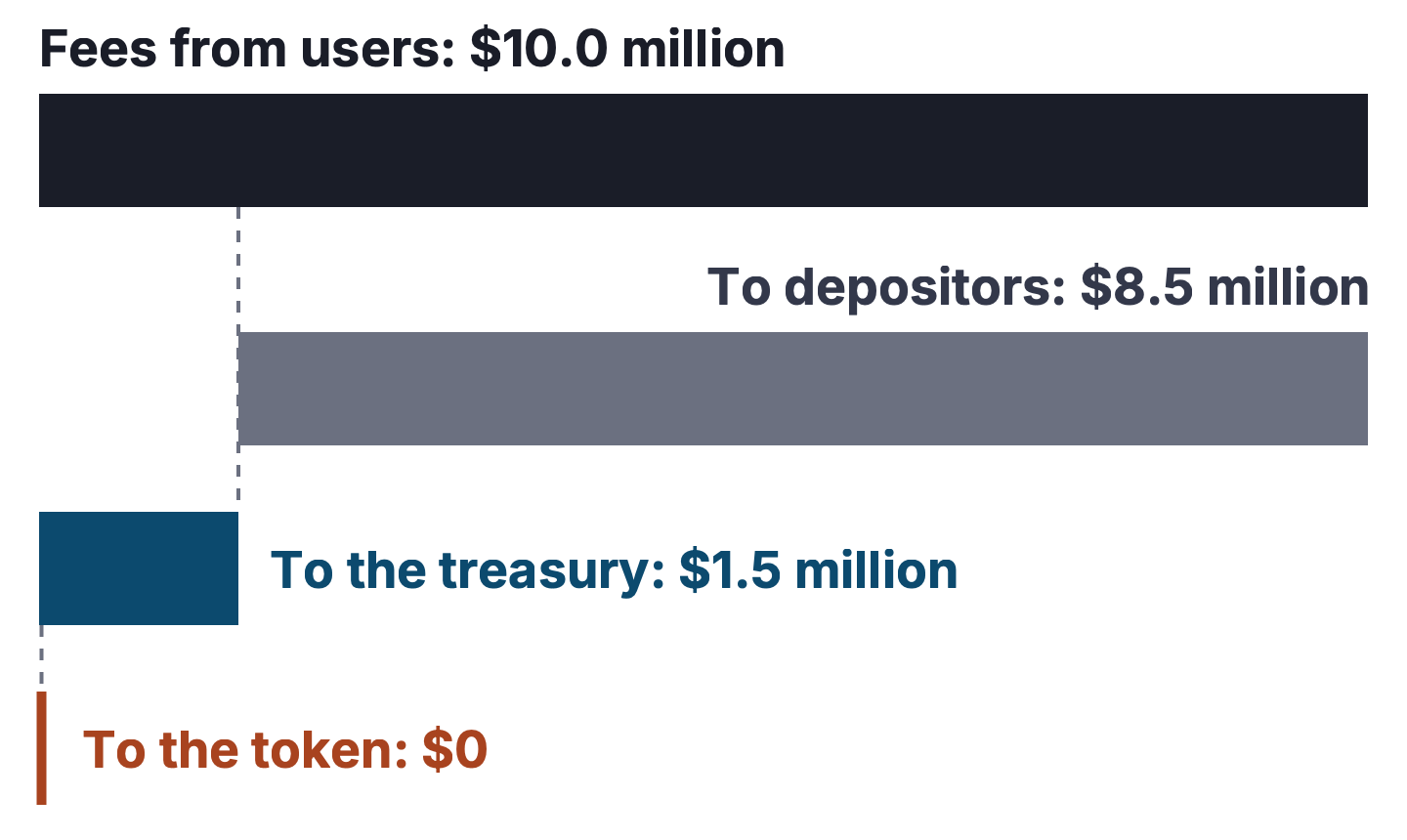
Exchange Q takes in $10.0 million from its users, and none of it reaches the token.
Exchange Q is busy, its users pay real money, and its token holders get none of it. They may hold a vote on whether to start a fee share one day, and that vote has some worth. It’s a different thing from a share of $1.5 million a year, so notice when a project talks up the vote and lets you assume the share.
Tell real use from paid-for use
Fees only mean something when they come from people who want the product. On a chart, real use and paid-for use look the same.
Real use
People using the product because it does something they need.
Paid-for use
People using it because the project pays them to, with new tokens handed out as rewards.
Paid-for use fades when the rewards stop. A project that hands out $5 of its own token to collect $1 of fees is buying its own numbers, and the cost lands on holders as new supply. Lesson 2 shows how that supply adds up, and lesson 4 shows where to set the fees against the deposits.
Learn from two tokens whose demand came from inside
Terra’s LUNA and FTX’s FTT are history, and they’re here for the pattern.
February 2023 · Terra and LUNA
In February 2023 the US Securities and Exchange Commission sued Terraform Labs, the company behind Terra and its token LUNA. It also sued the chief executive, Do Kwon. The SEC described UST as an “algorithmic stablecoin.” It was meant to hold one dollar through a swap with LUNA rather than through dollars in a bank.
The SEC said UST was advertised “as paying as much as 20 percent interest through the Anchor Protocol.” It also alleged that Terraform told investors “a popular Korean mobile payment application” settled payments on its blockchain in a way that “would accrue value to LUNA.” The SEC said that claim misled investors.
In May 2022 the design broke, and in the SEC’s words UST “depegged from the U.S. dollar, and the price of it and its sister tokens plummeted to close to zero.”
In April 2024 a jury found Terraform and Kwon liable for fraud. He later pleaded guilty in a criminal case, and in December 2025 he was sentenced to 15 years in prison.
December 2022 · FTX and FTT
FTT was the exchange token of FTX. In December 2022 the SEC charged Caroline Ellison with “manipulating the price of FTT, an FTX-issued exchange crypto security token.” Ellison had run Alameda Research, FTX’s sister trading firm, and the SEC said she acted at the direction of FTX co-founder Sam Bankman-Fried.
Part of the method was “purchasing large quantities on the open market to prop up its price.” The same release says “FTT served as collateral for undisclosed loans by FTX of its customers’ assets to Alameda.”
FTX filed for bankruptcy on 11 November 2022. In March 2024 Bankman-Fried was sentenced to 25 years in prison.
The demand that held each token up came from inside the project: an advertised rate of as much as 20 percent that drew people into UST, and an insider buying FTT.
So for any token, ask where the demand comes from, and whether it would still be there if the project stopped paying for it.
Spot a token with no job
Plenty of tokens launch with a name, a logo and a story and nothing else. Crypto from Zero gave CoinGecko’s count: more than half the tokens listed on its on-chain tracker since mid-2021 had stopped trading by the end of 2025.
When you research one, these are the questions that tend to go unanswered:
Is there a working product yet, or only a plan?
Would the product work just as well without the token?
Is the token’s only stated use a vote over a treasury made up mostly of the same token?
Does any fee reach holders, and if not, is there a dated plan for one?
Who holds most of the supply? Lesson 2 shows how to find out.
Each is a question the project should be able to answer in its own documents, whatever the answer. When it can’t, write that down. Lesson 4 gives you a page for it.
Your next step
Pick a project you’ve read about. Type defillama.com into your browser’s address bar yourself, or coingecko.com if the project isn’t on DefiLlama. Never arrive from a search result, ad or message.
Find the project there and follow the website link on its page.
Without connecting a wallet or signing anything, open its own documentation and write one sentence on which of the five jobs its token does, in the project’s own words. If you can’t find an answer, write that down too. It’s a finding.
If it’s on DefiLlama, look it up on the fees and revenue pages and see whether the holders revenue line shows a number or a blank. A blank can also mean the site doesn’t track that line for this project.
Last checked: 6 November 2026