Bitcoin: a fixed supply
Bitcoin is the oldest and the simplest. It does one thing: move value from one address to another, with no company behind it.
Its rules fix the supply at 21 million, and the number of new bitcoins created each year “is automatically halved over time until bitcoin issuance halts completely.” As of 1 November 2026, about 20.1 million had been mined, so the remaining 900,000 or so will arrive slowly, over a very long time.
Ethereum is different in kind. Its own site calls it “a decentralized blockchain network and software development platform,” which in plain words is a shared computer anyone can write programs for. The programs are called smart contracts, and they “let anyone create their own digital assets and decentralized applications.”
Ether (ETH) is that network’s own currency. You need it to pay the fee, called gas, for anything you do on the network, and validators lock it up as their deposit (lesson 2).
Unlike bitcoin, ether has no fixed cap. New ether is paid to validators and part of every fee is destroyed, so the supply drifts up or down with how busy the network is.
Tokens: assets built on someone else’s chain
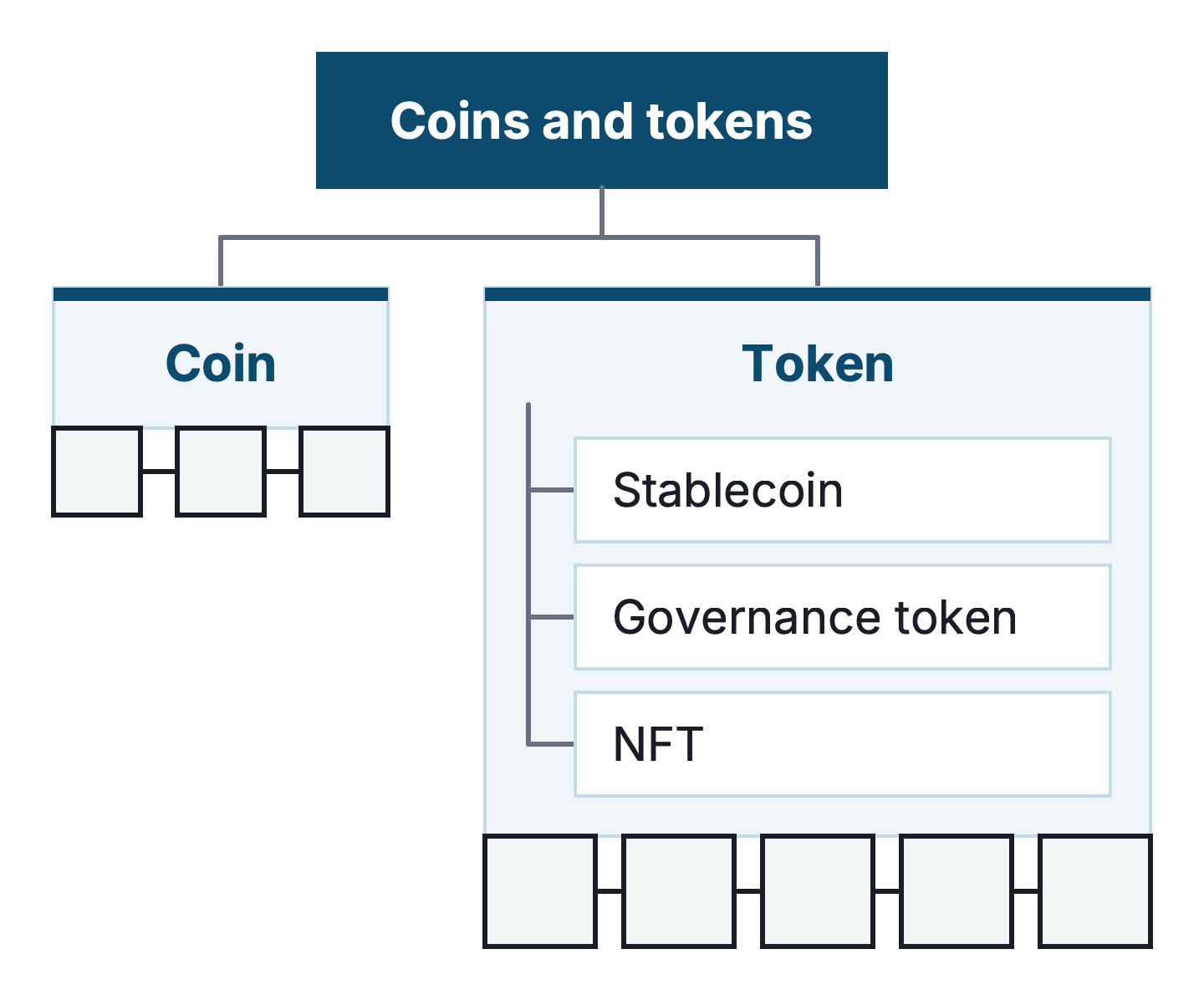
A coin is the native currency of its own blockchain. A token has no chain of its own: a smart contract on an existing chain such as Ethereum or Solana creates it and keeps a list of who holds how many. That list in a program is all a token is.
Anyone can write that contract in an afternoon, which is why there are so many. On 1 November 2026 CoinGecko listed about 22,700 active cryptocurrencies, and those are only the ones a listing site bothers to track.
Three kinds you’ll meet first:
Stablecoins, which get their own section below.
Governance tokens, which give holders a vote on how a project is run.
NFTs, or non-fungible tokens, where each token is unique and points at one thing, such as an image or a ticket. Ordinary tokens are interchangeable, like coins in a jar. An NFT is a receipt for one particular item.