Where yield comes from
Lesson 1 of 5
By the end of this lesson you’ll be able to name the four places a crypto yield can come from, ask who is paying it and what they get for it, and tell a company’s promise of interest from a rate a protocol actually earns.
Four pots, and only four
Every yield in crypto is paid out of one of four pots.
New coins the network creates to pay the people who run it.
Fees that users pay to trade or borrow.
Interest that borrowers pay on loans.
Tokens a project hands out to attract deposits.
That’s the whole list. A product that can’t say which pot it draws from is probably paying you out of other people’s deposits, which is a Ponzi scheme whatever it calls itself. Lesson 2 of Scams and How to Stay Safe shows how a fake platform works, stage by stage.
Who is paying, and what do they get?
Ask each pot who is paying and the answers differ.
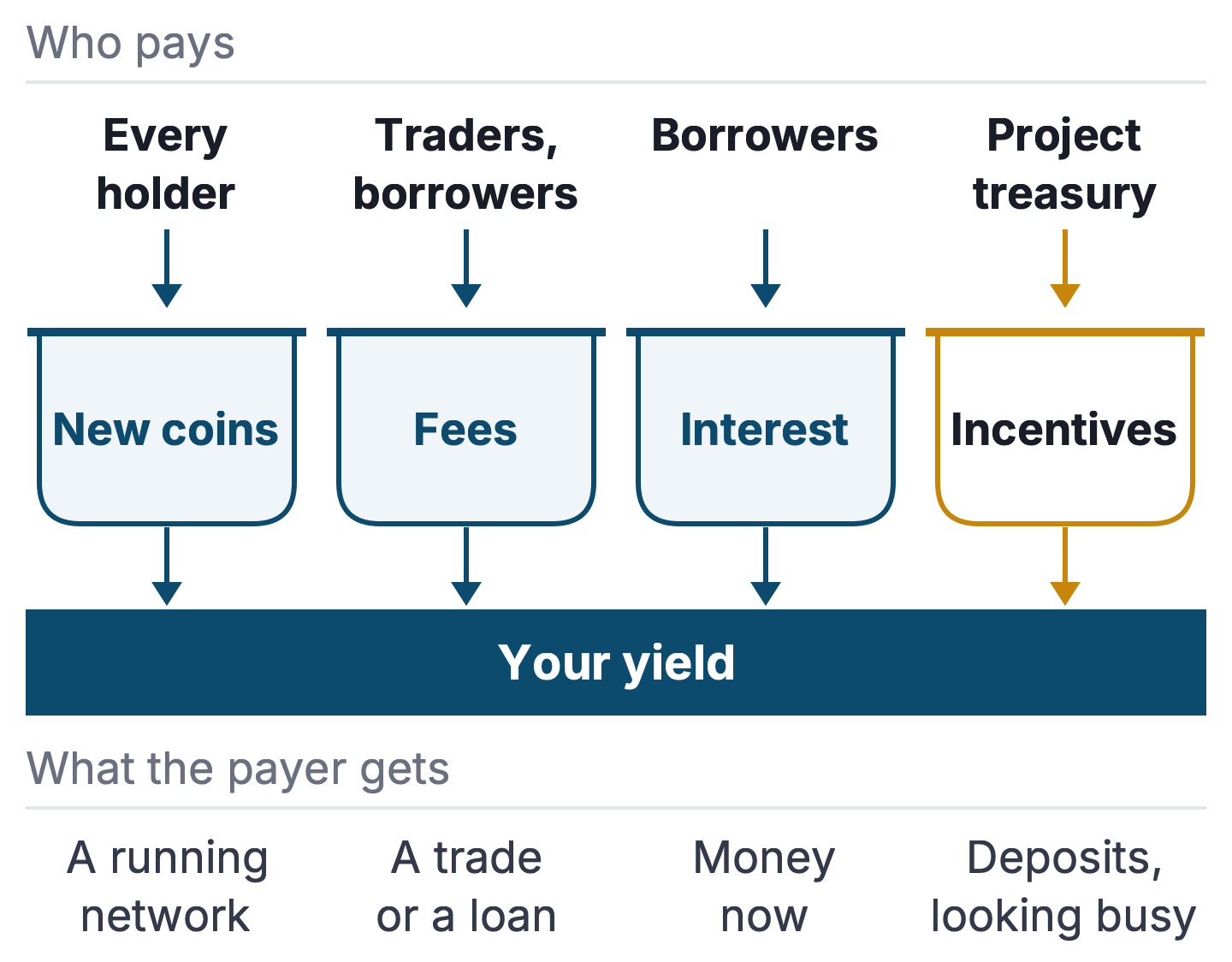
New coins: Paid by everyone who holds the coin, through dilution. Buys a network that keeps running.
Fees: Paid by traders and borrowers. Buys a trade or a loan.
Interest: Paid by borrowers. Buys money now.
Incentives: Paid by the project’s treasury. Buys deposits that make it look busy.
The first three payers get something they want, which gives the payment a reason to continue, at a rate nobody promises. The fourth gets your presence, and nothing else. It stops when the budget runs out or when the project decides it has enough deposits, and lesson 4 shows what happens then.
New coins are everyone’s coins
Staking rewards are the clearest case of the first pot. ethereum.org says validators “are rewarded with ETH for attesting to the state of the chain and proposing blocks,” and that the amount issued each day “fluctuates based on the total amount of ETH staked.”
Every coin paid to a staker that way didn’t exist the day before. If you hold the coin and don’t stake, your share of all the coins shrinks a little each day, unless the network burns more than it creates. So a staking reward measured in the coin is partly a transfer from the holders who don’t stake to the ones who do, with transaction fees on top.
That doesn’t make it worthless. Dilution alone is still no reason to stake, because staking brings the risks lesson 2 goes through.
A yield figure tells you how many coins arrive, and nothing about whether the coin will be worth more.
Three companies that promised a rate
A custodial “earn” account
In a custodial “earn” account you hand your coins to a company and the company sets the rate. Your coins leave your control, and the rate is whatever the company says it is.
A protocol
In a protocol the rate comes out of a formula you can read, and the coins sit in a contract rather than on a balance sheet.
The contract has its own ways of failing, which lessons 3 and 4 cover. It can’t decide to spend your deposit on something else, though whoever holds an upgrade key may be able to change what it does, and lesson 6 of How DeFi Works shows how to check.
Celsius, BlockFi and Voyager all sold the first kind, and all three failed in 2022.
13 July 2022 · Celsius
More than $4 billion in deposits, the FTC says
Celsius told customers they could earn rewards “as high as 18 percent annual percentage yield (APY),” that it was “safer” than a bank, and that it held “a $750 million insurance policy for deposits,” according to the US Federal Trade Commission (FTC). Its Earn Interest Program, in the words of the US Securities and Exchange Commission (SEC), was one “by which investors tendered their crypto assets to Celsius in exchange for interest payments.”
The SEC says Celsius “effectively halted its platform on June 12, 2022.” It filed for bankruptcy on 13 July 2022. The FTC’s complaint says Celsius “misappropriated these deposits totaling more than $4 billion,” and in July 2026 its three founders were ordered to pay $16.5 million to settle the FTC’s charges.
In January 2023 the bankruptcy court ruled that Celsius’s terms of use had passed ownership of Earn deposits to the company, which left those customers as unsecured creditors.
28 November 2022 · BlockFi
BlockFi sold interest accounts. The SEC’s description: “investors lent crypto assets to BlockFi in exchange for the company’s promise to provide a variable monthly interest payment.” In February 2022 BlockFi agreed to pay $100 million in penalties, and the SEC found it had “made a false and misleading statement for more than two years on its website” about the risk in its loan book.
In November 2022 BlockFi stopped withdrawals, citing its exposure to FTX, and filed for bankruptcy on 28 November 2022.
July 2022 · Voyager
More than $1 billion lost, the FTC says
Voyager’s app told customers “YOUR USD IS FDIC INSURED.” The FTC’s answer: “the FDIC does not insure crypto assets at all,” and the deposits weren’t eligible. On 28 July 2022 the FDIC and the Federal Reserve wrote to Voyager demanding it stop.
By then Voyager had frozen its customers’ accounts and filed for bankruptcy, and the FTC says customers “lost more than $1 billion in crypto assets.”
The same thing went wrong three times.
The rate was a marketing number. The coins were lent on to other firms, and the promise was only as good as the company’s balance sheet. When the company failed, the customers became creditors in its bankruptcy, waiting for a share of what was left.
APR, APY and the unit
Any rate also carries a compounding convention and a unit, and both need reading before you believe it.
APR is the simple yearly rate. APY is the rate with compounding included, or, in Aave’s glossary, “the yield/interest after a year, including compounding interest.”
As arithmetic on a made-up figure, a 10 percent APR compounded daily is about 10.5 percent APY. Advertisers quote whichever looks bigger, and a rate preceded by “up to” is the best case for the shortest time.
The unit matters more than the compounding. A yield paid in a token is a yield in that token. With made-up numbers, earn 20 percent in a token that falls 40 percent and you’ve lost 28 percent.
After a 20 percent yield$120
After the token falls 40 percent$72
Made-up numbers: $100 of a token, a yield paid in that token, then a fall in its price.
A yield in a dollar stablecoin is a dollar yield, as long as the stablecoin holds its dollar, which the Stablecoins course covers.
Your next step
Take one yield you’ve seen advertised this month. Never reach its site through the ad, and keep your wallet disconnected.
Write down which of the four pots it comes from, who is paying and what they get, what unit it’s paid in, and who holds the coins while it’s earning. If you can’t fill in all four from the product’s own pages, you have your answer about that product.
If you can, you have its claims and nothing more, and Celsius could have filled in all four. So read the terms you’d sign to see who owns the coins once you’ve deposited them. If a firm holds them, look it up on a regulator’s own register, which shows only that the firm is listed.
Last checked: 13 November 2026