
Money with no bank in the middle
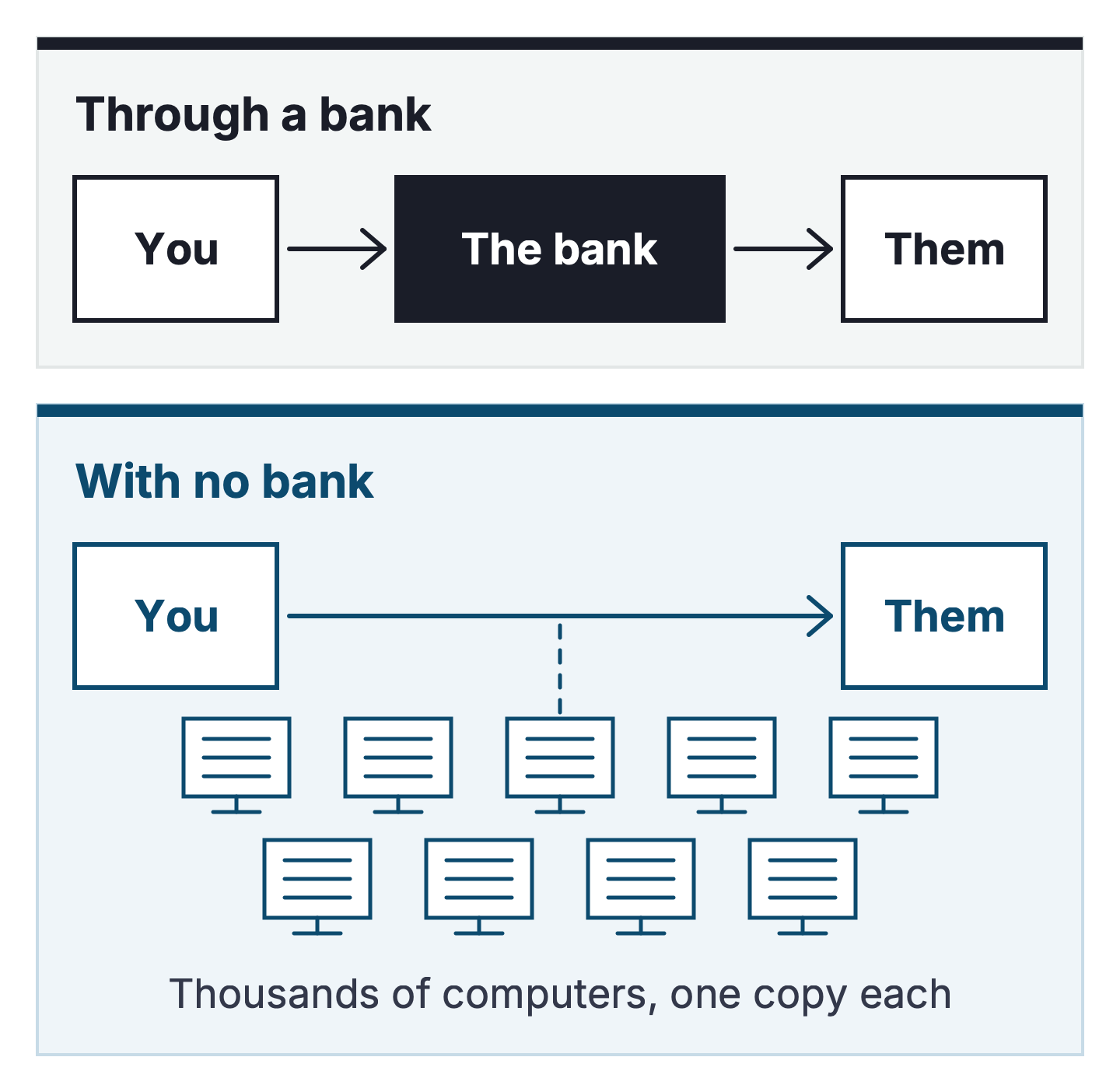
When you pay someone from your bank account, the bank does the work. It checks you have the money, moves the number from your account to theirs, and keeps the record. Both of you trust the bank to get it right.
Crypto removes the bank from that sentence. In 2008 a person or group writing as Satoshi Nakamoto published a nine-page paper describing a system that would let payments go “directly from one party to another without going through a financial institution.” That system became Bitcoin, and every cryptocurrency since has borrowed the idea.
The record is kept instead by thousands of computers around the world, all holding the same copy and all checking each other. Lesson 2 shows how they agree. For now, hold on to the shape: one shared record, no company in charge of it, and nobody who can quietly change it.
What that gives you
The first thing is that nobody can stop a payment of bitcoin or ether you hold yourself. A bank can freeze an account or refuse a transfer.
A crypto network runs every hour of every day and doesn’t know who you are. If you hold the keys to your coins, you can send them to anyone, anywhere, and no one has to approve it. Stablecoins are different: the company that issues one can block its token.
The second is that the record is public and permanent. Every bitcoin payment ever made sits on the Bitcoin blockchain, where anyone can look it up. That’s a strange idea if you’re used to bank statements, and the next section shows its cost.
It also means the supply, the history and the rules are open to inspection. Bitcoin’s rules say only 21 million bitcoins will ever exist, and you can check the count yourself.
What it takes away

There is no undo. The Bitcoin FAQ puts it in one line: “Bitcoin transactions are irreversible: once confirmed, they can only be refunded by the person receiving the funds.”
Send coins to the wrong address and they’re gone. Send them to a scammer and the scammer has them.
There is no helpline. With a bank, a forgotten password is an inconvenience.
With your own crypto wallet, the secret that controls your coins is yours alone, and no company holds a copy. Lose it and nobody can restore it, because there’s nobody to ask.
Lesson 3 explains that secret, and the course Your First Wallet, Set Up Safely shows you how to keep it.
There is no privacy either, or not much. Bitcoin’s own documentation says it “is not anonymous and cannot offer the same level of privacy as cash.” Your name isn’t on the blockchain, but your address is, and anyone who links the address to you can read your whole payment history.
Fees exist too. Something has to pay the computers that keep the record.
On Bitcoin, the fee goes to the miner who adds your payment to the chain. On Ethereum it’s called gas and is paid in ether.
The amount moves with how busy the network is. It can be a few cents, or many dollars on a bad day.
Bank account against crypto wallet
Read the wallet card twice. Each line that gives you control also means nobody will help you. That’s the deal, and it’s the same deal for everyone who holds crypto, from a first-time buyer to a fund.
What crypto isn’t
Nobody runs Bitcoin or Ethereum. There’s no company behind either, no customer-service desk to write to, and as Ethereum’s own site puts it, “There’s no CEO, board, or central authority.”
When something goes wrong, the people who can help are the people you chose to deal with, such as an exchange, and only as far as their terms allow.
No coin is a sure thing. Bitcoin has lost more than three quarters of its value twice in the last ten years, and lesson 5 goes through those falls with dates. Anyone who tells you a coin can only go up wants something from you.
Crypto isn’t one thing, either. Bitcoin is a currency with a fixed supply.
Ethereum is a shared computer that other people build on. A stablecoin tries to sit at one dollar.
Thousands of other tokens exist, and most of them fail. Lesson 4 sorts them out.
Last checked: 5 November 2026