What money is, and why people trust it
Lesson 1 of 6
By the end of this lesson you’ll be able to say what money does, name who creates the money in your bank account, and follow a card payment from the register to the banks’ books. Bitcoin was built as an answer to that last system, so it helps to see the system first.
What money does
Money does three jobs, and anything that does all three can serve as money. The Bank of England puts them plainly.
Exchange
Money “is considered a reliable medium of exchange between buyer and seller.”
Store
It lets you store value: “It allows us to store the face value of a coin or banknote.”
Measure
And it gives everyone one measure, because “money offers a shared standard that everyone can use, making it easy to compare prices.”
None of the three works without trust. A note in your pocket is paper, and a balance in your account is a number on a bank’s computer. Both are worth something because you expect the next person to take them at the same value.
The Bank of England says the same of the pound: “This system relies on public trust in the government and its management of the economy.”
Hold on to the word trust. Every form of money in this lesson, bitcoin included, stands or falls on who people have to trust and how far.
From shells to coins to paper
The forms changed; the three jobs didn’t.
Cowry shells
China, documented from 1300 BC. Scarce, durable and hard to fake.
↓
Bronze and copper shells
China, around 1000 BC. The metal itself.
↓
Coins of electrum, a gold and silver alloy
Around 700 BC, in Lydia in what’s now western Turkey. The metal itself.
↓
Paper notes
China, around the 7th century.
↓
Goldsmiths’ receipts
The UK, around the 1660s. A promise to pay the bearer on demand.
↓
Bank notes
The Bank of England, from 1694. Deposits held at the bank.
When and where each form appeared, then what stood behind it.
Each step made money easier to carry and easier to trust at a glance. Each also moved the trust one step further from the thing itself.
A gold coin was its own guarantee. A paper note was a promise about gold held somewhere else, and whoever made the promise had to keep it.
Bretton Woods, and the day it ended
For most of the century before 1914, and again from 1944, the big currencies were promises about gold. The last version was agreed at Bretton Woods in New Hampshire in July 1944. Other countries kept their currencies “fixed but adjustable (within a 1 percent band) to the dollar,” and the dollar was “convertible to gold at a fixed exchange rate of $35 an ounce.”
15 August 1971 · The gold window closes
The end of $35 an ounce
On the evening of 15 August 1971, President Nixon announced on television that the United States would stop converting dollars into gold.
The Federal Reserve’s own history records the first instruction from that weekend at Camp David: “The first order was for the gold window to be closed.” The result, in the same account: “in effect, the international monetary system turned into a fiat one.”
Fiat means by decree. Since that day, the dollar and the other big currencies have had nothing behind them except the conduct of the institutions that issue them, and the dollar has done its three jobs for 55 years on that basis. Trust in institutions is also where the Bitcoin white paper starts, as lesson 2 shows.
Who creates money now
You might picture a central bank printing the money you use. Notes and coins are the small part. In the Bank of England’s words, “The vast majority of money in the UK is held electronically as bank deposits.”
Those deposits aren’t printed by anyone. In a 2014 paper the Bank explained “how the majority of money in the modern economy is created by commercial banks making loans.”
When a bank lends you money for a car, it credits your account with a new deposit. Repay the loan and that money disappears again.
So the money in your account is a claim on your bank. The bank owes it to you, a deposit guarantee scheme stands behind the bank up to a limit, and the central bank stands behind the system. Each layer has a name, an address and rules it has to follow.
Follow a card payment
A card payment looks instant. Underneath, it runs in two stages through five parties, and Visa’s own description of the process shows how many hands your money passes through.
Stage one is authorization, which the terminal shows as approved or declined:
1
You present your card, and the shop sends an authorization request to its own bank, called the acquirer.
2
The acquirer “electronically sends the authorization request to VisaNet,” Visa’s network.
3
“VisaNet routes the request to the cardholder’s issuer,” which is your bank.
4
Your bank “approves or declines the transaction,” and the answer travels back the same way to the register.
Stage two is clearing and settlement, which is when money moves:
1
The shop deposits the transaction with the acquirer.
2
The acquirer “credits the merchant’s account and electronically submits the transaction to VisaNet for settlement.”
3
“VisaNet pays the acquirer and debits the issuer account, then sends the transaction to the issuer.”
4
Your bank “posts the transaction to the cardholder account and sends the cardholder a monthly statement,” and you pay the bank.
Count the ledgers. The shop, its bank, the network, your bank and you each keep a record. The payment is complete only when all five agree.
Any one of them can refuse, reverse or delay it, and the banks and the network each take a fee.
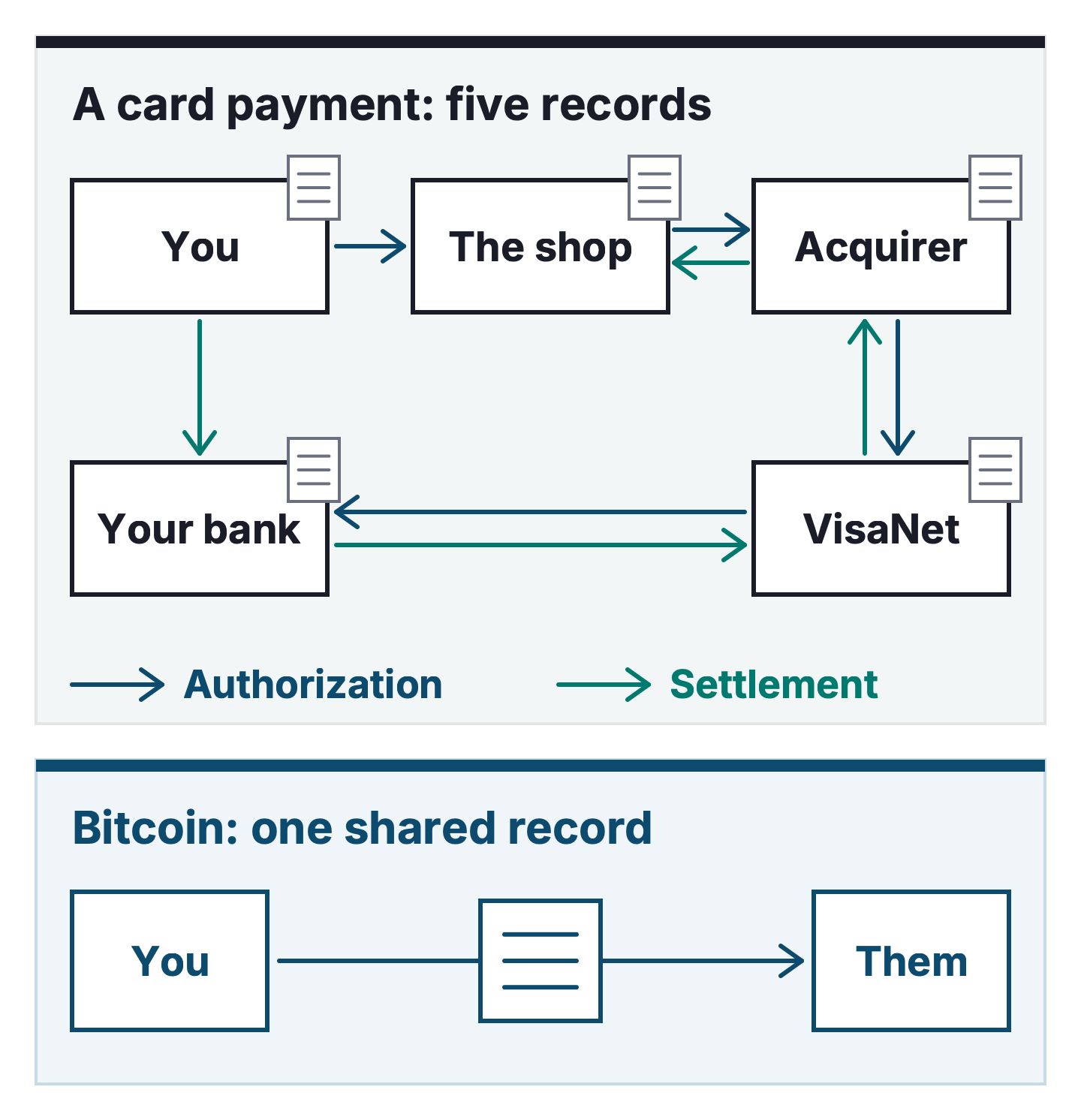
Five parties, five records. Authorization runs from the shop to your bank and back. Settlement moves the money the other way.
That’s the machine Bitcoin was designed to do without: one shared record instead of five, kept by nobody in particular. Lesson 2 traces how the idea was built.
Your next step
Open your last bank or card statement and pick one card payment. Write down the four parties besides you and, for each one, what they learned about you from that payment.
Keep the list. When lesson 3 shows you a bitcoin payment, compare the two.
Last checked: 6 November 2026