
This website uses cookies

Read our Privacy policy and Terms of use for more information.

In your own wallet

Lesson 3 of 4
After this lesson you’ll know what changes when the keys are yours, what you take on, and whether it’s worth it for you.
A collage. An enormous deep blue egg lies in a nest of twigs at the top of a bare tree. A small man in a dark suit and bowler hat sits hunched on top of it, his arms around his knees.

What changes when you hold the keys

The coins are entries on the blockchain. A wallet holds the keys that can move them, and nothing else. Whoever has the keys owns the coins, in the only sense the network recognizes.
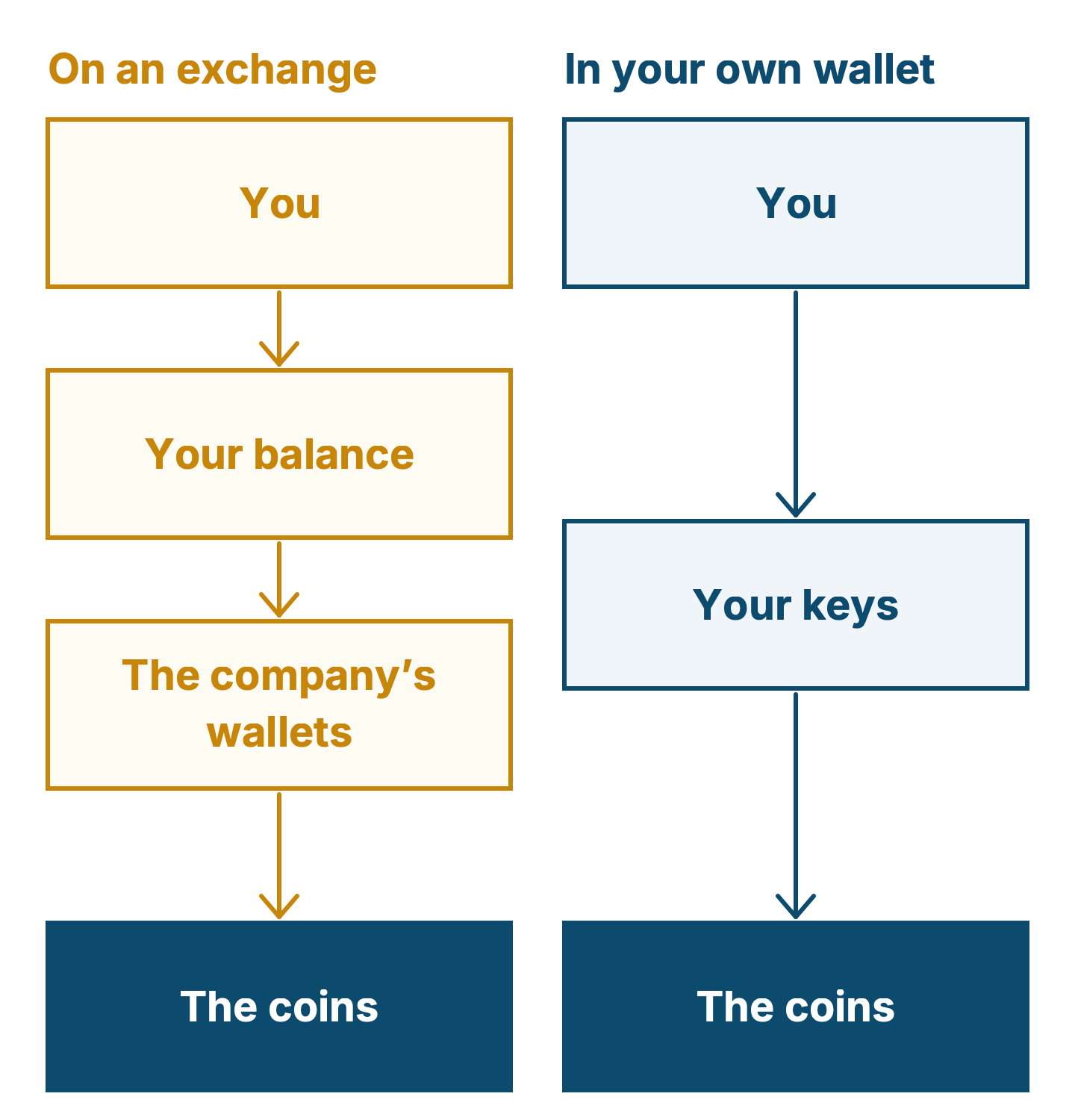
Two paths down to the same coins. On an exchange: you, your balance, the company's wallets, the coins. In your own wallet: you, your keys, the coins.
Holding your own keys takes the company out of the path.

When you hold the keys, there’s no company between you and your money. Nobody can freeze your bitcoin or ether, or limit your withdrawals. Nobody can go bankrupt with your coins inside, or decide you’re no longer a customer.

The balance you see is what you have, with no promise attached. Stablecoins are different: the company that issues one can block its token.

When the Central Bank of Ireland warned people holding coins with unauthorized providers, its advice was to move them to an authorized provider “or to a self-hosted wallet.” A self-hosted wallet is a wallet whose keys you hold.

Subscribe to keep reading

This content is free, but you must be subscribed to The Crossover to continue reading.

I consent to receive newsletters via email. Sign up Terms of service.

Already a subscriber?Sign in.Not now