
This website uses cookies

Read our Privacy policy and Terms of use for more information.

Through a fund

Lesson 2 of 4
After this lesson you’ll be able to say what a bitcoin ETF actually holds and what it costs. You’ll also know where you can buy one, and what you give up compared with owning the coin.
A collage. A snow-streaked mountain sits on a wooden breadboard, cut into slices like a loaf. One slice near the end, printed in deep blue, leans out from the others.

What a spot ETF holds

An exchange-traded fund, or ETF, is a fund whose shares trade on a stock exchange like any company’s shares. A spot bitcoin ETF buys bitcoin and keeps it with a custodian, a specialist firm that holds the keys.

The fund issues shares, each worth a slice of the pile. You buy the shares through the broker you already use.
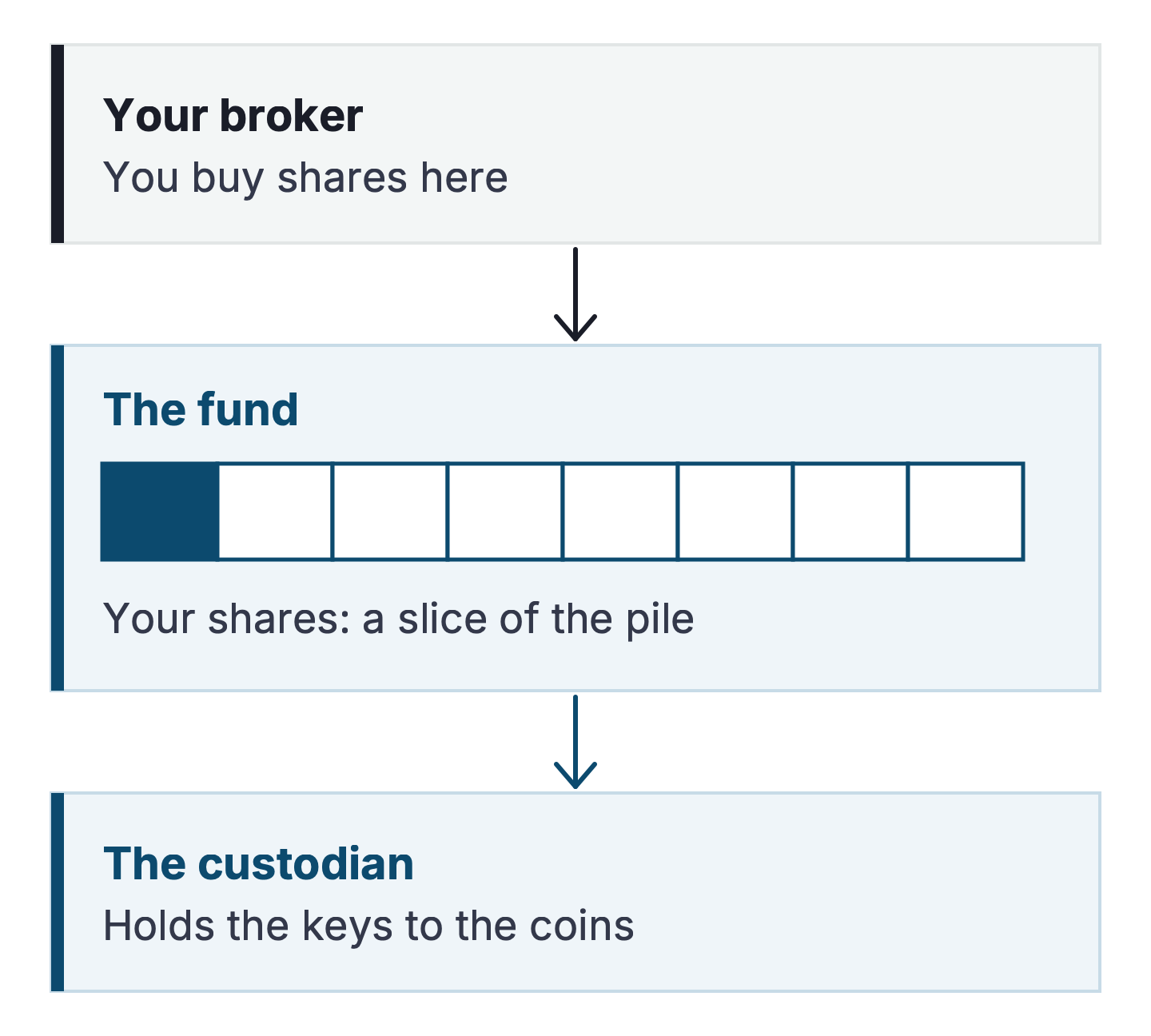
A path down the page. Your broker, where you buy shares, then the fund, drawn as a bar of eight slices with one filled in for your shares, then the custodian, which holds the keys to the coins.
From your brokerage account to the coins.

“Spot” means the fund holds the coin itself. An earlier kind of fund held futures contracts, agreements to buy or sell at a set price on a later date, which is a different thing with its own costs.

The US Securities and Exchange Commission (SEC) approved the first spot bitcoin ETFs on 10 January 2024. Gary Gensler, its chair at the time, said that day: “we did not approve or endorse bitcoin.” The SEC cleared the exchanges to list spot ether funds on 23 May 2024, and the first of them began trading on 23 July 2024.

What you own is a share in the fund. You don’t own any coins, you can’t send them anywhere, and you can’t use them to pay for anything. If you want the coins themselves, you sell the shares and buy coins elsewhere.

Subscribe to keep reading

This content is free, but you must be subscribed to The Crossover to continue reading.

I consent to receive newsletters via email. Sign up Terms of service.

Already a subscriber?Sign in.Not now