
Minting and redeeming
A cash-backed stablecoin starts with a bank transfer. A customer sends the issuer dollars, the issuer puts the dollars into its reserve and creates the same number of tokens, and the customer gets the tokens. That’s minting.
Redeeming runs the same way in reverse. The customer returns tokens, the issuer destroys them and pays out the dollars.
Circle, the issuer of USDC, puts the promise in one line: “USDC is always redeemable 1:1 for US dollars.” The EU’s crypto law makes the same thing a rule, requiring issuers to “issue e-money tokens at par value and on the receipt of funds” and to redeem them “at any time and at par value.”
Most holders never do either. Only approved customers deal with the issuer directly.
Circle’s terms say that “Only Users Type A can redeem USDC directly with Circle,” and those are businesses with a Circle Mint account. Tether’s fee schedule sets a minimum of “100,000 USD” to buy or redeem with the company, with a redemption fee of “The greater of $1,000 or 0.1%.”
How traders pull the price back
The big customers can get a dollar from the issuer, and they’ll move whenever the market offers them less.
Suppose a stablecoin slips to 98 cents on exchanges. A trading firm with a redemption account buys one million tokens for $980,000, sends them to the issuer and gets $1,000,000 back.
That’s $20,000 before fees, and the firm will repeat it. All that buying pushes the exchange price back up toward a dollar.
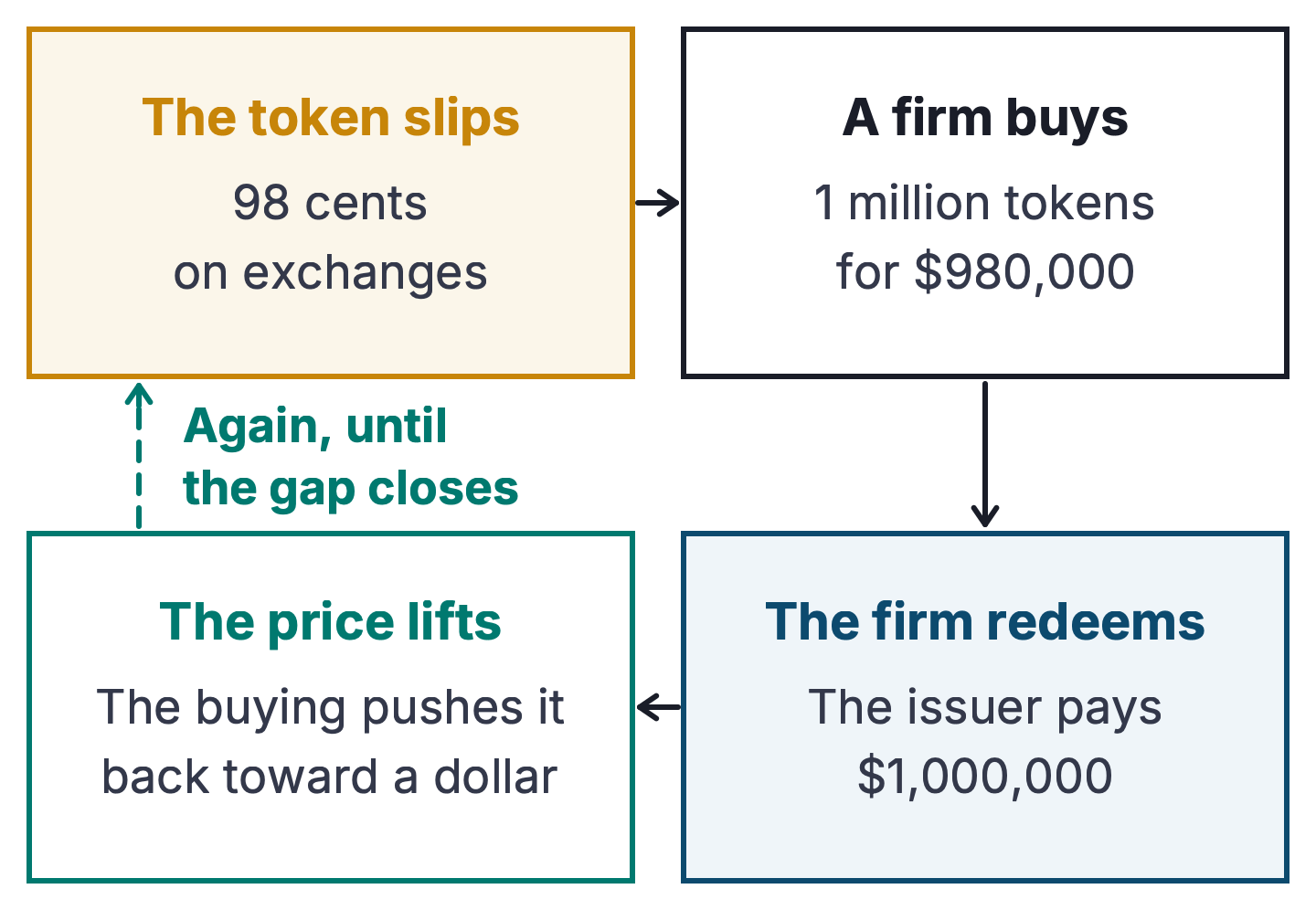
The reverse works too. If the token trades above a dollar, a firm sends the issuer $1,000,000, mints a million tokens and sells them for more than it paid, which pushes the price down.
Four designs
How a stablecoin fails depends on what sits behind the token.
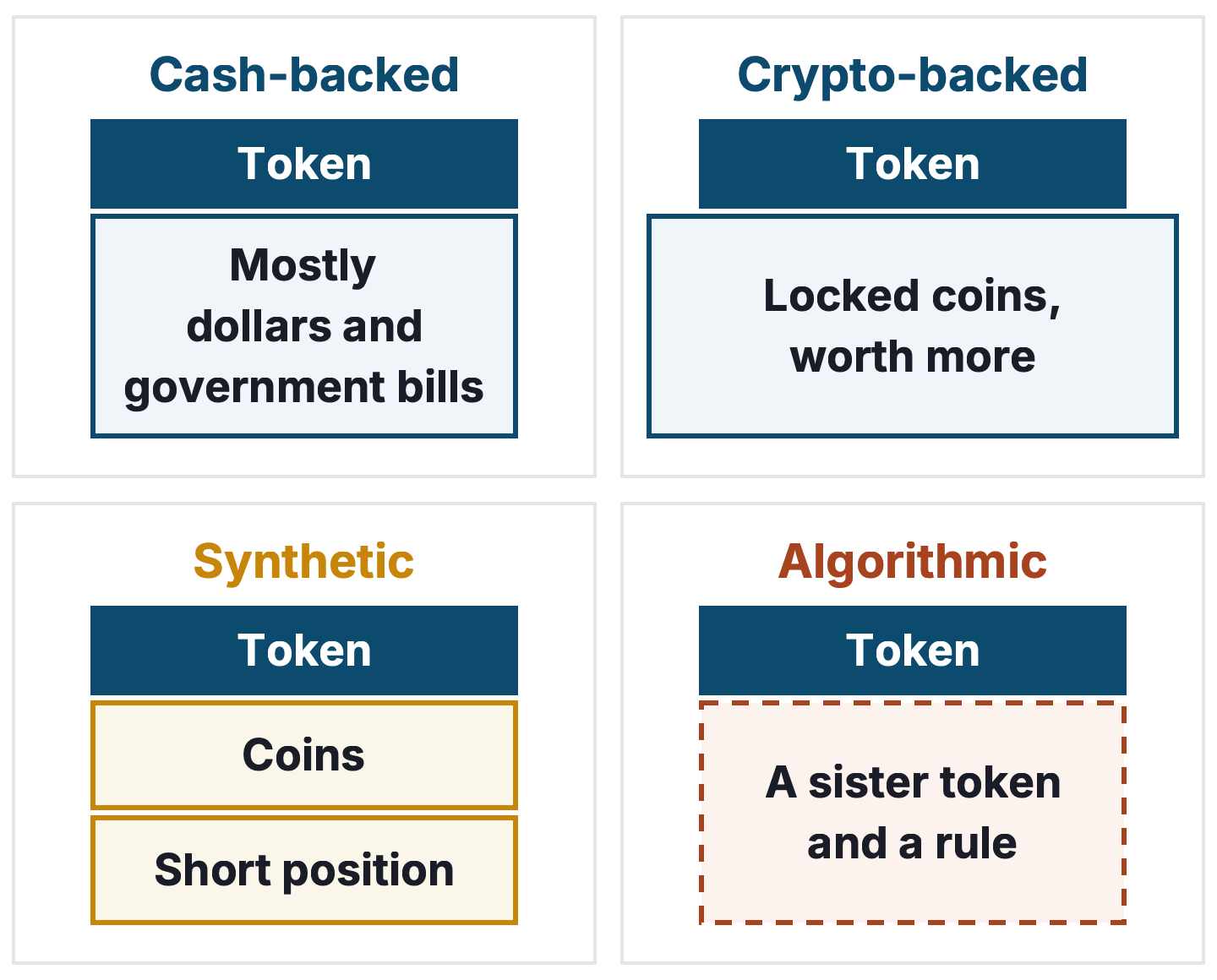
The crypto-backed design works like a secured loan. Say a borrower locks $150 of ether and receives 100 dollar-tokens against it. If ether falls 25 percent, the collateral is still worth $112.50, more than the tokens.
If it keeps falling, the contract sells the collateral to cover the tokens before it’s worth less than them. Sky’s own risk document says what that leaves: USDS “aims to hold a stable value but may not do so at all times.”
Sky’s coins began this way. Its own page now lists crypto vaults as one part of their backing, beside USDC, real-world assets and money deployed through its Sky Agents, its “largest asset category,” so a problem with USDC or those investments reaches them too.
The synthetic design is newer, and Ethena doesn’t call USDe a stablecoin at all. Its documents describe “a synthetic dollar, backed with crypto assets and corresponding short futures positions.”
A short position gains when the price falls, which offsets a fall in the collateral. Traders on the other side have historically paid Ethena to hold it, which is part of Ethena’s income, and that payment can reverse.
USDe’s hedge is now the smaller part of its backing: Ethena’s governance forum put hedged bitcoin and ether at 17 percent on 30 September 2026, and stablecoins and lending at 74 percent. Germany’s regulator BaFin says “Trading in USDe tokens on the secondary market is no longer permissible in the European Union.”
Why Terra failed
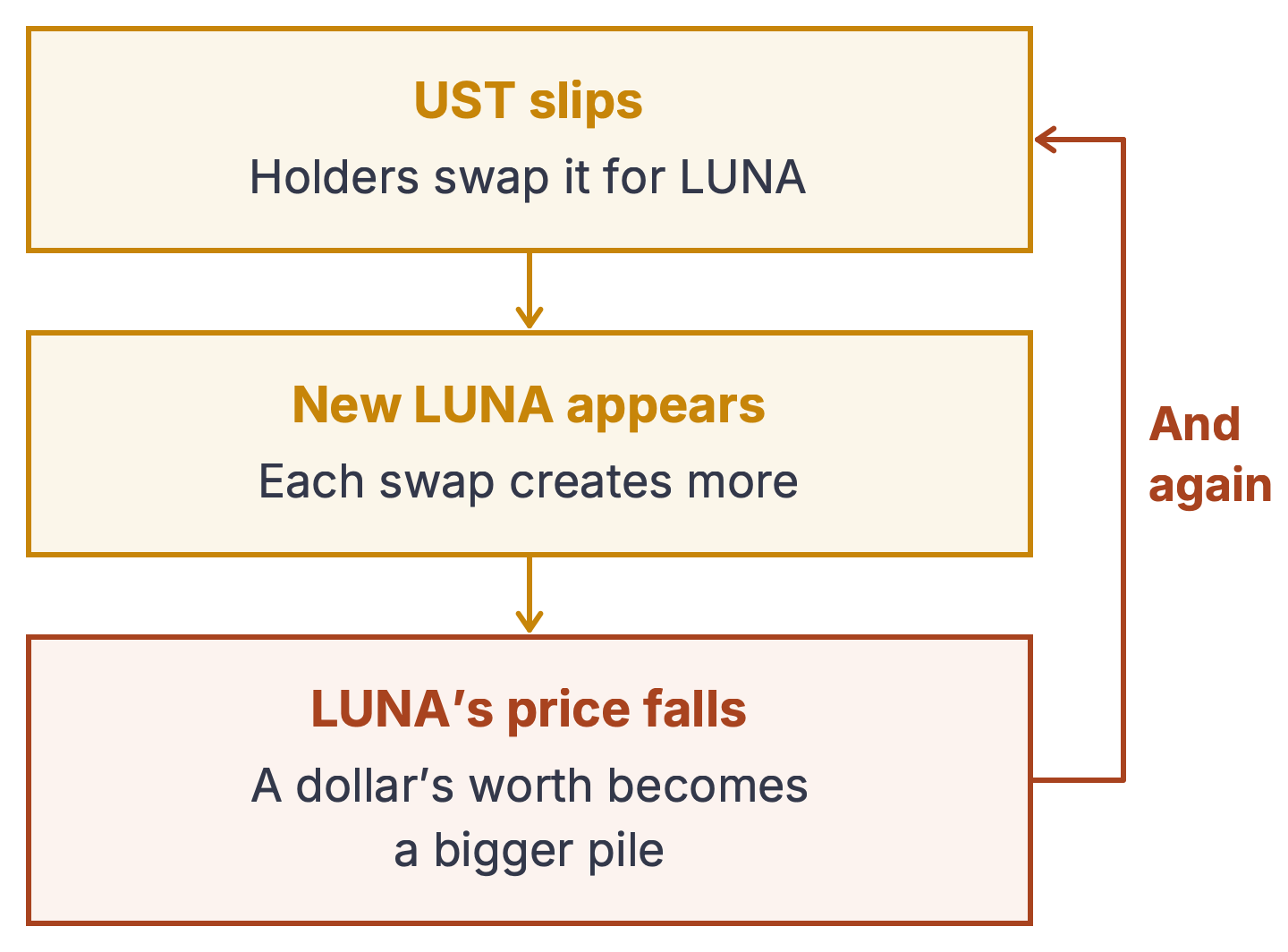
TerraUSD, or UST, had no reserve its holders could claim on. It held its dollar through a rule: one UST could always be swapped for a dollar’s worth of its sister token, LUNA, and back.
The demand came from a lending app. UST was, in the words of the US Securities and Exchange Commission, “advertised as paying as much as 20 percent interest through the Anchor Protocol,” and Terraform Labs and its founder “raised billions of dollars from investors.”
In May 2022 large holders sold, UST slipped, and holders rushed to swap it for LUNA. Each swap created new LUNA, LUNA’s price fell, and a dollar’s worth of LUNA became a larger and larger pile of a coin nobody wanted.
The Luna Foundation Guard, a Singapore nonprofit set up to defend UST, went from more than 80,000 bitcoin on 7 May to 313 by 16 May, and the peg still broke.
Tokenized money funds are a different thing
You’ll see a few tokens on stablecoin lists that aren’t stablecoins. BlackRock’s BUIDL is one: DefiLlama counted it among the stablecoins, with about $1.9 billion outstanding on 6 November 2026.
It’s a share in a fund that “invests 100% of its total assets in cash, U.S. Treasury bills, and repurchase agreements,” recorded as a token. BlackRock’s launch announcement in March 2024 said the fund “seeks to offer a stable value of $1 per token and pays daily accrued dividends directly to investors’ wallets as new tokens each month.”
That makes it a security. The US law on stablecoins draws the line in its definition of a payment stablecoin, which leaves out any digital asset that is “a security.”
How big the market is
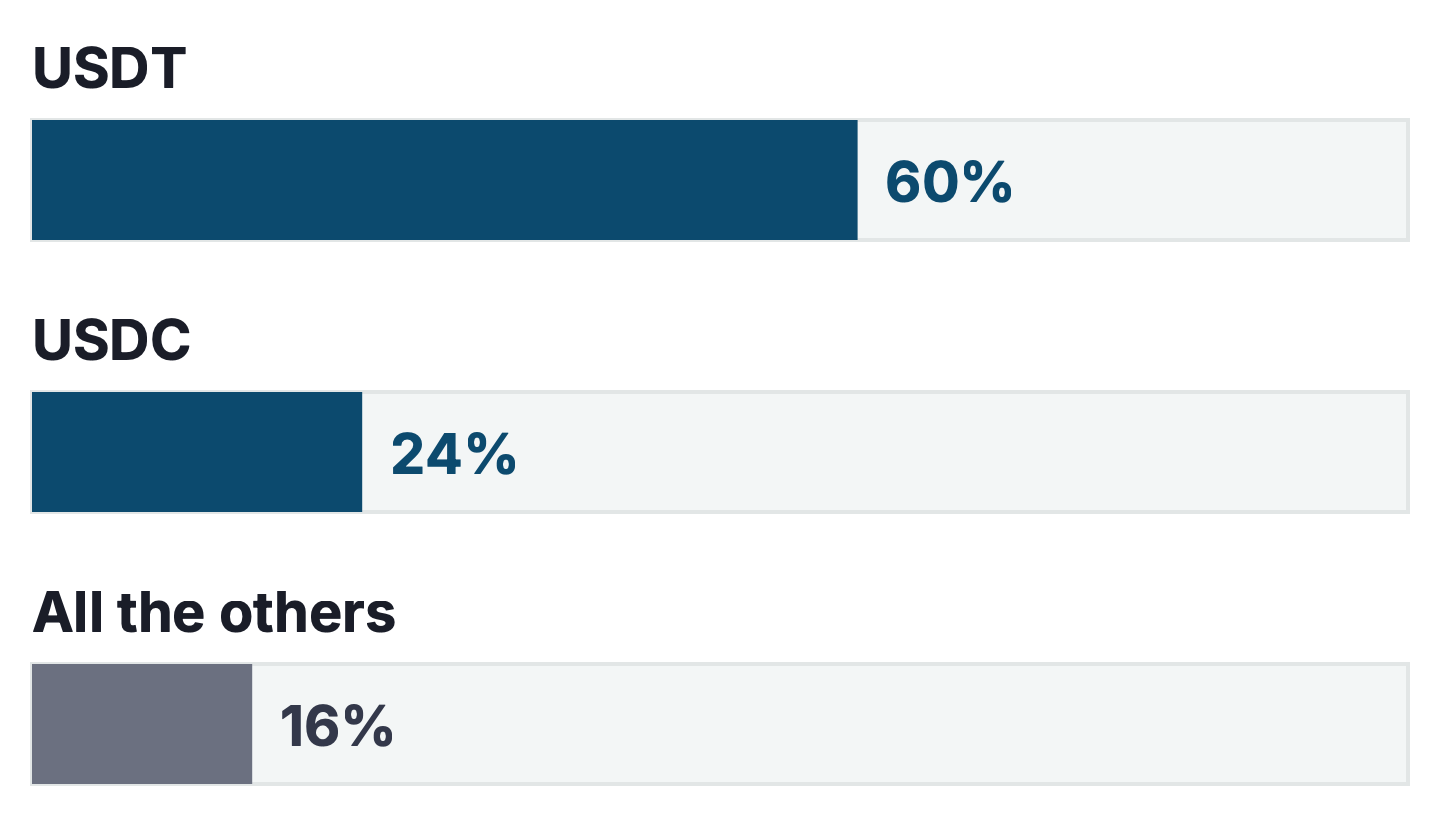
On 6 November 2026, DefiLlama put the value of all dollar stablecoins at about $294 billion. Tether’s USDT was 60 percent of it and Circle’s USDC 24 percent, so two cash-backed coins make up 84 percent of the market.
Sky’s and Ethena’s coins are each a few billion. Those shares move, so check the date on any figure.
Last checked: 6 November 2026