
How Ethereum changes
Bitcoin changes slowly and rarely. Ethereum changes on a schedule.
Every year or so, the people who write its software agree on a bundle of changes, test it on practice networks, and switch it on at a set block or epoch. ethereum.org keeps the full list: each item has a name and a date, and most have a block or epoch number.
The names are odd (a city, a star) and the content is technical, but the pattern is simple: an upgrade changes the rules every computer on the network follows, all at the same moment. Nothing happens to your coins: they’re in the same account afterward, and ethereum.org says so plainly for the Merge: “Any funds held in your wallet before The Merge are still accessible after The Merge.”
That matters because scammers use upgrade names.
Ethereum’s upgrades, dated
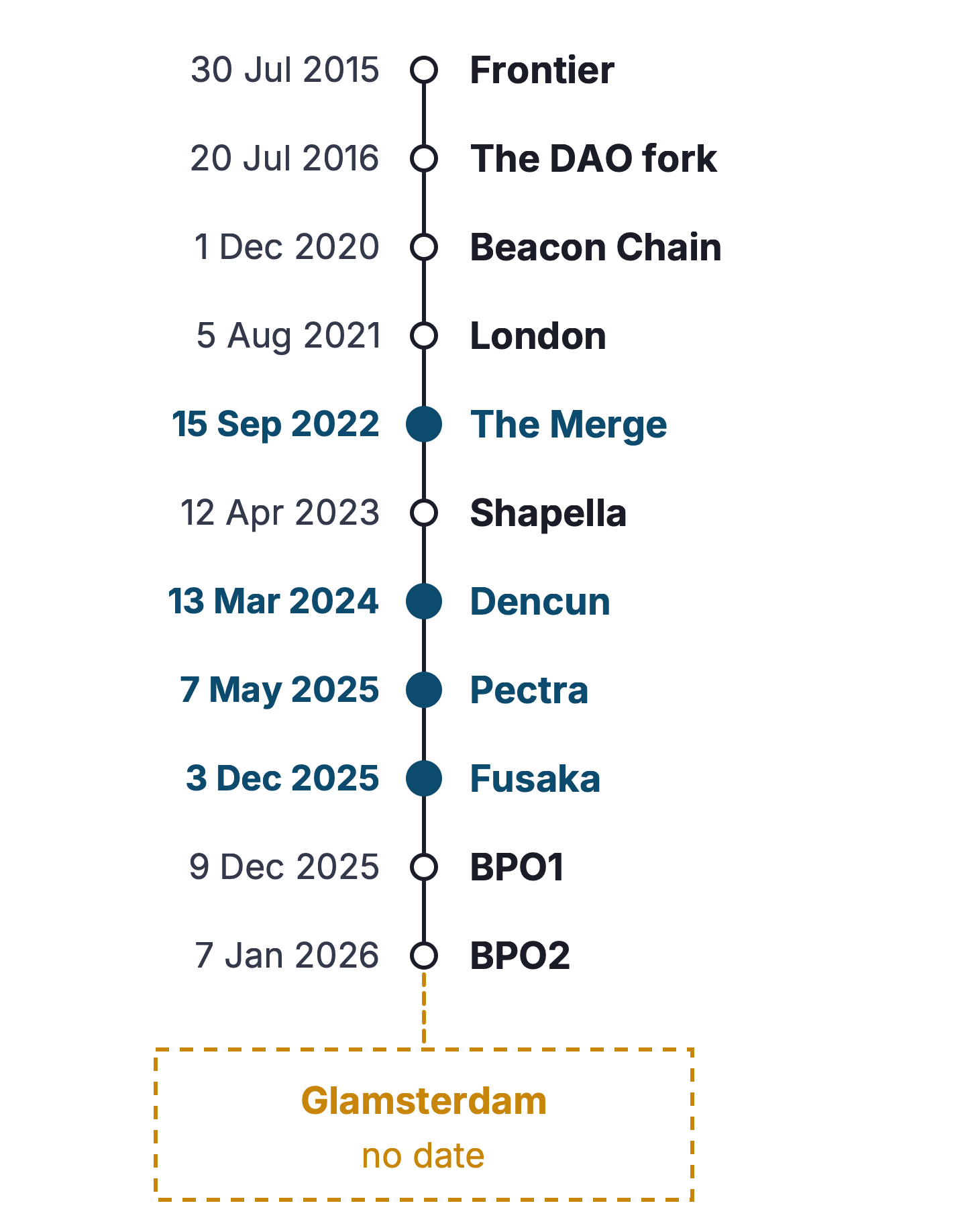
Thirteen more upgrades sit between those dates and matter less to a holder today; this line keeps the ones that matter most.
The Merge: mining ends
For its first seven years Ethereum worked like Bitcoin. Miners raced to solve a puzzle, and the winner added the next block. On 15 September 2022 that stopped.
The Merge joined the mining chain to the Beacon Chain, which had run since December 2020 with validators instead of miners, and “its major feature was switching off the proof-of-work mining algorithm.”
Ethereum’s energy use fell by about 99.95 percent, by ethereum.org’s own figure. And the way new ether is created changed, from paying miners to paying validators, which lesson 2 picks up when it looks at supply.
Dencun and the blobs
Layer 2 networks, which lesson 6 covers, run transactions off Ethereum and post the data back to it. Until March 2024 they posted that data in the same expensive place as everything else.
Dencun gave them blobs: a separate data space attached to each block, cheaper, and deleted after about 18 days once nobody needs it. The target was three blobs a block.
Pectra and Fusaka, the two you live with now
Pectra went live on 7 May 2025. It let an ordinary wallet address borrow features from smart contracts, such as paying for several actions in one transaction (EIP-7702, lesson 7).
It let one validator hold up to 2,048 ETH instead of 32, so large stakers run fewer validators (EIP-7251, lesson 5). And it doubled the blob target from three to six.
Fusaka, on 3 December 2025, was built for the layer 2s. PeerDAS lets each node keep a fraction of the blob data and still be sure all of it exists, so the network can carry more blobs without every computer storing them all.
Validators had raised the gas limit, the amount of work a block can hold, to 60 million a week earlier, and Fusaka made that the default.
Fusaka also added a rule that lets developers raise blob limits between big upgrades. They used it twice, in small forks named BPO1 and BPO2: on 9 December 2025 the blob target went to 10, and on 7 January 2026 to 14, with a maximum of 21.
Glamsterdam, as of 6 November 2026
The next upgrade is Glamsterdam. Its headline changes separate the work of building a block from proposing it (EIP-7732) and add a list to each block of everything it touched, so nodes can check transactions in parallel (EIP-7928). ethereum.org’s page, last updated on 16 October, still gives the target as “Q4 2026 · Date not yet confirmed.”
Glamsterdam went live on the Sepolia test network on 6 October and was due on the Hoodi test network on 26 October 2026. On 22 October the developers postponed that “to allow for further investigation of interactions of EIP-8037 with mainnet smart contracts,” and said “A new activation date has not been set.”
On 6 November the Ethereum Foundation’s blog said the audit firm ChainSecurity had found projects that would be vulnerable after the upgrade, and that the developers will “not fork Hoodi until the issues are resolved.” Lesson 8 explains how a date gets set, and where you’ll read it.
Last checked: 13 November 2026