
What you actually own
Lesson 1 said the record is public and shared. Follow that through: your bitcoin don’t sit on your phone or inside a device.
They’re entries on the blockchain, assigned to an address. What you hold is the ability to move them, and that ability is a secret number called a private key.
Bitcoin’s white paper defines a coin as “a chain of digital signatures.” Each time coins move, the owner signs the transfer with their private key, and every node can check the signature against the public half of the key without ever seeing the secret.
Apps will ask you to sign things too, and one signature, such as a token approval, a permit or a blind signature you can’t read, can hand your tokens to someone else, so never sign anything you don’t understand. Your First Wallet, Set Up Safely shows what you’re signing.
Private key, public key, address
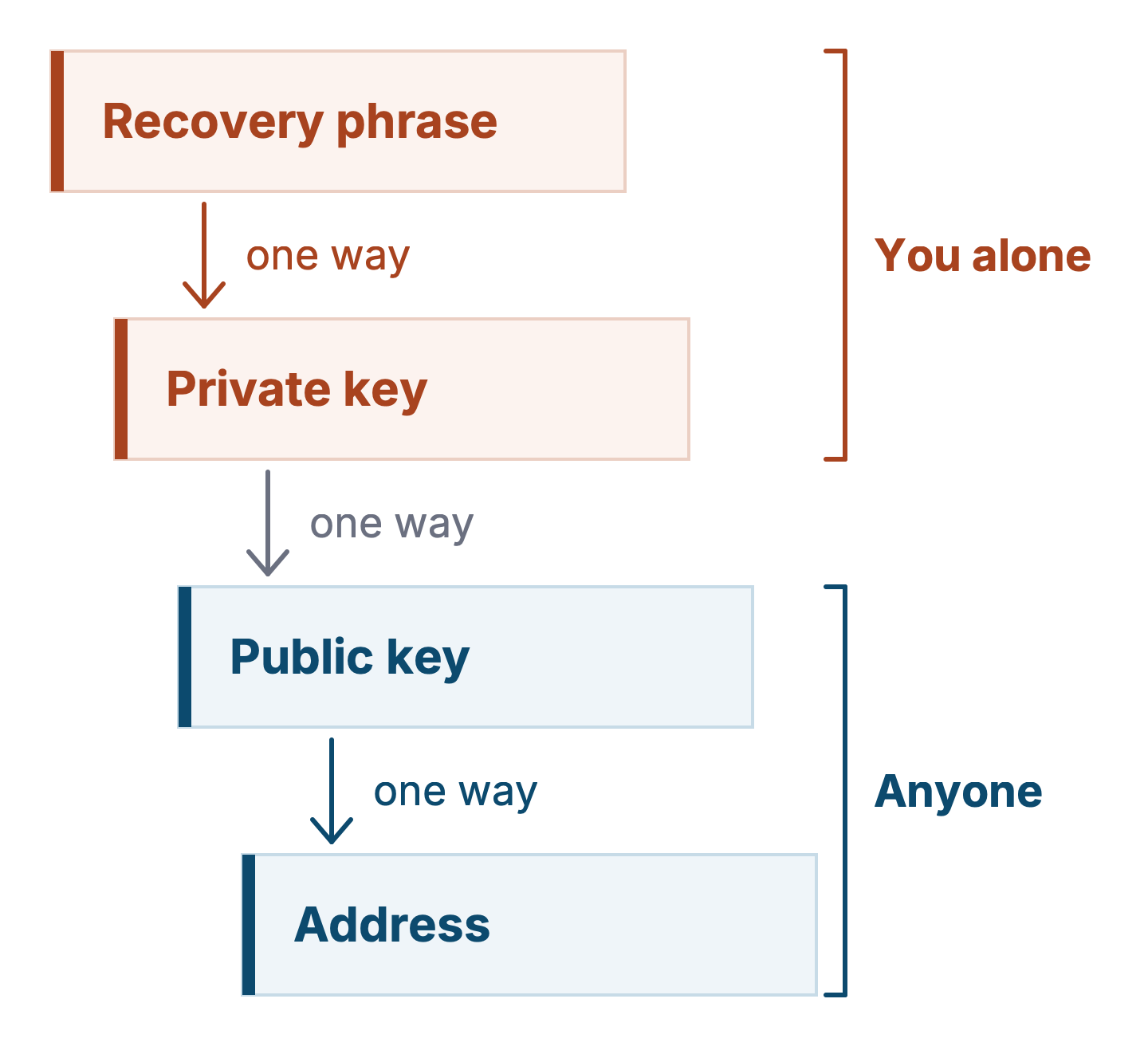
The private key is a very large random number, made by your wallet software when you set it up. Ethereum’s documentation says a private key “grants you custody over the funds associated with your account,” and adds: “It is vital to keep your private keys safe.”
The public key is calculated from the private key. The calculation works one way only. Anyone can use the public key to check a signature, and nobody can work backward from it to the private key.
The address is a shortened form of the public key, and it’s the thing you give to people who want to pay you. On Ethereum it’s the last 20 bytes of a hash of the public key, written with “0x” in front. Bitcoin’s format looks different, but the idea is the same.
And when you pay someone, you compare every character with the address they gave you, and you never copy one from your transaction history. Thieves make look-alike addresses that match the first and last few characters of a real one, and Your First Wallet, Set Up Safely shows how to check before you send.