
This website uses cookies

Read our Privacy policy and Terms of use for more information.

The risk curve

Lesson 2 of 5
By the end of this lesson you’ll be able to place anything you hold on a line from least to most that can go wrong, say what each step along it adds, and see why how much you put in each place matters more than which coin you chose.
A collage of a vast tree bough reaching out over a dark gorge and thinning to a twig. A tiny man in an overcoat crawls along the thin end toward one blue fruit hanging from the very tip.

Line assets up by what can go wrong

Picture every crypto asset on one line. At the near end sit the things that have run longest and have the fewest ways to fail. At the far end sit tokens that launched last week, or haven’t launched at all.

Each step out adds a new way to lose money, on top of the ones already there.

That line is the risk curve, a way to see what you’re carrying rather than a list of things to buy. It ranks nothing as good or bad.
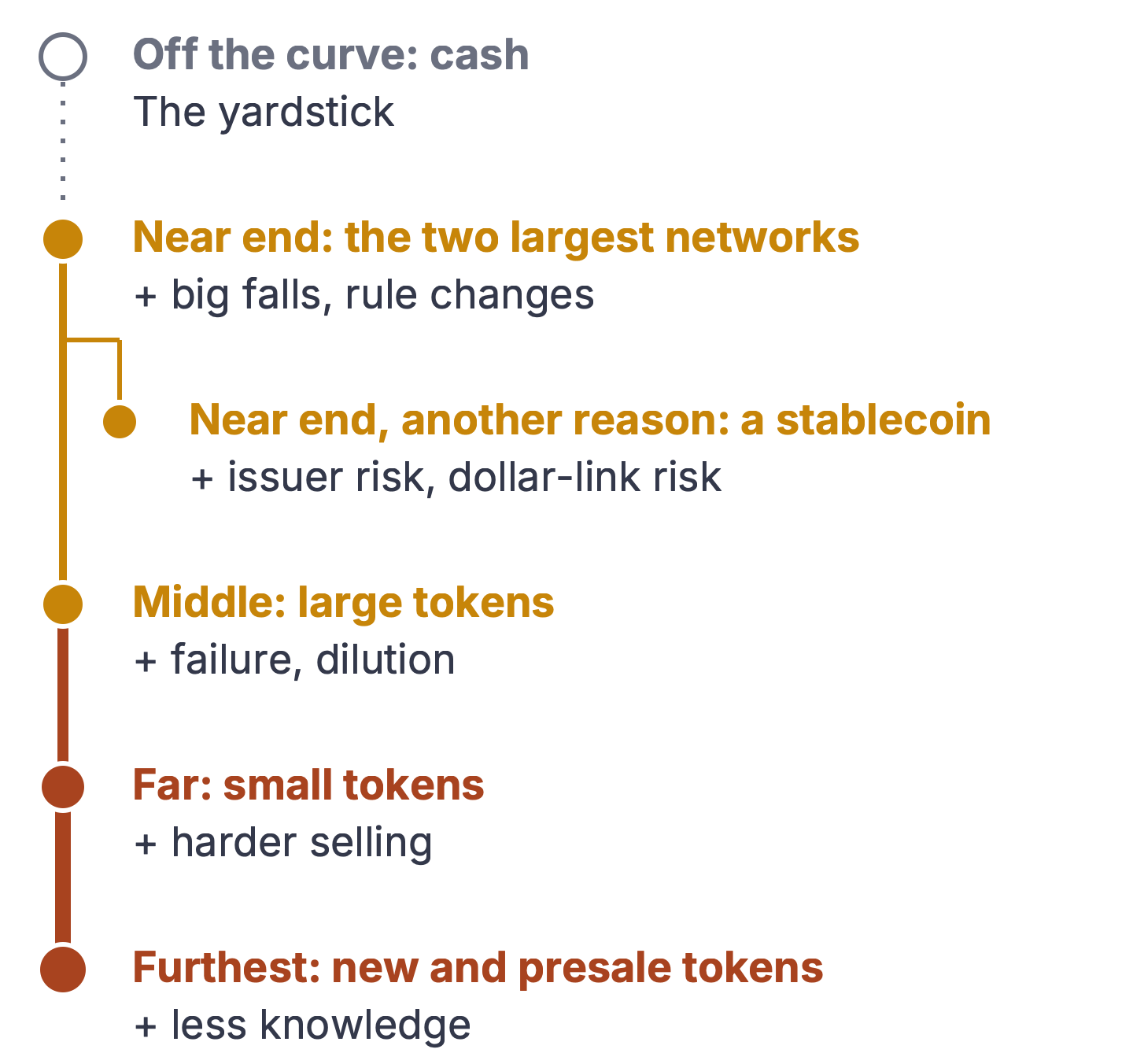
A line running down the page, heavier at each step, with cash in grey above it, joined by dots. Off the curve: cash, the yardstick. Near end, in amber: the two largest networks, adding big falls and rule changes. On a branch, near end for another reason, in amber: a stablecoin, adding issuer risk and dollar-link risk. Middle, in amber: large tokens, adding failure and dilution. Far, in rust: small tokens, adding harder selling. Furthest, in rust: new and presale tokens, adding less knowledge.
Where on the curve each kind of asset sits, and what can go wrong there.
Off the curve: Cash in an insured bank account. Inflation; a bank failure above the insured limit.
Near end: The two largest networks, each more than a decade old. Falls of more than three quarters; a change in the rules you live under.
Near end, for a different reason: A stablecoin from an authorized issuer. The issuer fails or freezes it; the dollar link breaks (the Stablecoins course).
Middle: Large tokens with years of history. The near-end falls and rule changes, plus the project or its team failing, and new supply arriving.
Far: Small tokens. The middle’s risks, plus too few buyers when you want to sell.
Furthest: New launches and presale tokens. The risks of small tokens, plus tokens you can’t sell yet, insiders who sell first, and outright theft.

Cash sits off the curve because it’s the yardstick. Everything on the curve can lose more than cash can.

A stablecoin sits at the near end for a different reason: it’s built to hold a dollar, so its price stays steady until something breaks. An authorized issuer is no insurance. The Central Bank of Ireland says that even under the EU’s crypto rules there are “no safeguards like those in place for traditional financial products,” such as a deposit guarantee.

Continue with The Crossover Pro

The rest of this story, plus two paid editions a week. $24.99 a month, or $249 a year. Already a member? Sign in above.

Subscribe to Pro